Powered by Podetize
Links from this Podcast:
Free Joseph Website: http://www.freejoseph.net
Society for the Protection of New Hampshire Forests: https://forestsociety.org/
Pioneers of Crowd Funding & Conservation

Deep in a Dorchester Woods
The Society for the Protection of NH Forests has pioneered conservation innovations since their founding in 1901.
Including A Podcast Conversation with Jack Savage, President SPNHF
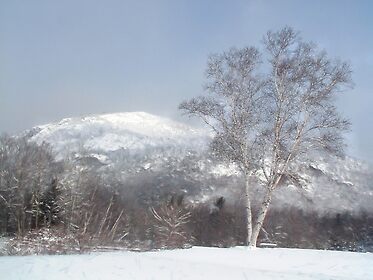
I stood today on the summit of Welch Mountain and looked into the Sandwich Range accessed largely along the “Road Through Sandwich Notch” of which Elizabeth Yates wrote more than a century ago although she is best known for her book Amos Fortune- Free Man.
At one time the town of Sandwich, to which the Notch Road is now the backcountry gateway, was a provincial capital of New Hampshire. All along this road are the stone walls, cellar holes, and other signs of a day when the population of Sandwich was considerably larger.
The Notch Road into Sandwich is a beautiful backroad trip today, passing by Beede Falls, Cow Cave and Pulpit Rock where in the 1800s townsfolk would gather at the base of this huge Glacial Bounder and listen to the local preacher as he stood atop the rock delivering his sermon.
Sandwich Notch might have been developed over the years except for the good works of a number of local folks and the Society for the Protection of New Hampshire Forests.
Yet Sandwich Notch is only one of the Notches that the Society for the Protection of New Hampshire Forests has saved through the good works and generosity of thousands of members and friends. You may already know oftheir good works. but did you know that they led the way to making crowdfunding a “thing”?
Now it can be argued that "crowdfunding" is nothing new.
My Iroquois ancestors gathered together to help one another build their longhouses even before the Peacemaker and Hiawatha brought the Great Law to them more than 500 years ago. Early European settlers joined with one another to build barns or homes. However, there is no question that among the earliest efforts by nonprofit groups was the effort in the 1920s to save Franconia Notch through - among other things - the sale of "deeds" to a square foot of the Notch or the "purchase" of a tree, allowing thousands of people from across the nation to get involved with conservation efforts.
In just 120 years the Society has been at the forefront of change that has rippled out from the social and political boundaries of New Hampshire to the nation. Their founding effort to help pass the Weeks act not only resulted in the White Mountain National Forest but spread the National Forest fever across the continent.
There are very few organizations with which I share such a common kinship. So many of their efforts, focused on the lands and the people I am closest to, have become touchstones in my own life. The rallying point of their formation - the fight to save the forests of the White Mountains, and to protect the water resources, eventually led to adoption of the Weeks Act and the establishment of the National Forest in Congress. Their opposition to building a 4 lane super-highway through Franconia Notch resulted in the only scenic parkway of the Interstate highway system. The protection of Crawford Notch, Sandwich Notch, Lost River and the prevention of a ridgeline drive across the Presidential Range too were achieved with their leadership.
These epic battles were among the tales I would tell as I guided trail clearing, hiking and backpacking trips in the Whites in my early adult life. Even earlier they were the topics of dinner conversations around the family table at my home as a young boy.
Listening to my grandmother describe how she felt when she donated a hard-earned $10.00 to buy one square foot of tallis slope on the side of Cannon Mountain to protect Franconia Notch made me feel that I was part of a grand tradition here. I watched with admiration as my Mom and Dad helped lead the efforts to clean up the Pemigewasset River with other remarkable people like Pat & Tom Schlesinger of New Hampton, Syd and Olivia Howe, Dr. Larry Spencer at Plymouth State.
Later in my own home, around that same family table, my Senate office team would strategize ways to carry on that tradition: rebuilding the historic Smith Covered Bridge after it was burned by an arsonist, sponsoring the NH River's Protection Act, the Land Conservation and Investment Program, and conserving Livermore Falls.
The Forest Society served as inspiration for all of this, over the years developing a conservation ethic part John Muir - the preservationist - and part Gifford Pinchot - the architect of "wise use".
To some, it appeared that they were taking the safer, more moderate route to their destination. No one ever accused the Forest Society of being wild-eyed environmentalists; but to the great grandson of an Iroquois man and an Abenaki woman it seemed (and still seems) right . . . a part of the Circle; where people are neither beneath or above but an integral part of the whole.
When you venture out this summer - especially if you do so here in New Hampshire - say a quiet thanks to the generations of people who have helped to build the Society for the Protection of New Hampshire Forests. Because of them the White Mountain National Forest, Franconia Notch, Crawford Notch, Sandwich Notch and other sacred places of these white hills will forever be wild and free.
About Wayne D. King: Wayne King is an author, artist, activist and recovering politician. A three-term State Senator, 1994 Democratic nominee for Governor; he is the former publisher of Heart of New Hampshire Magazine and CEO of MOP Environmental Solutions Inc., and now a columnist for the New Hampshire Center for Public Interest Journalism (inDepthNH.org) where he writes “The View from Rattlesnake Ridge” and hosts two Podcasts: The Radical Centrist (www.theradicalcentrist.us) and NH Secrets, Legends and Lore (www.nhsecrets.blogspot.com). His art (www.waynedking.com) is exhibited nationally in galleries and he has published three books of his images and a novel "Sacred Trust" a vicarious, high voltage adventure to stop a private powerline - all available on Amazon.com. His art website is: www.waynedking.com , and his writing site: http://bit.ly/WayneDKing . He now lives in Thornton, New Hampshire at the base of Welch Mountain where he proudly flies both the American and Iroquois Flags.
Society for the Protection of New Hampshire Forests
https://forestsociety.org/
Jack Savage is President of the Society for the Protection of New Hampshire Forests. He was appointed as the Forest Society’s fifth President in September 2019. Previously the Vice President of Communications/Outreach at the Forest Society for 14 years, he has been a key contributor to many of the Forest Society’s successes over the last decade. He has guided the organization’s evolving use of digital media to accomplish its land protection and advocacy goals, and overseen the expansion of its education and volunteer programs.
Savage’s family has roots in the forest products industry — they owned the Charleston Lumber Company in Charleston, W.V. in the 20th century. He and his wife, Cheryl, now make their home in a historic farmhouse in Middleton, NH, where they have lived with their dogs and horses since 1993.
As a writer and publisher, Savage has had broad experience in newspapers, magazines, and book publishing. He is a former editor of NH Profiles magazine, publisher of NH Seacoast Sunday newspaper, and operator of his own company, Carriage House Publishing. Savage is also a founding board member and past president of the New Hampshire Writers Project.
A certified Tree Farmer, Savage is active in his community, serving for the last 12 years as town moderator and formerly as selectman, chair of the Planning Board, and chair of the ZBA. As a volunteer and member of the regional conservation group Moose Mountains Regional Greenways, Savage helped facilitate the Forest Society’s conservation of more than 2,000 acres in the Moose Mountains range.
jsavage@forestsociety.org
Franconia Notch Documentary
Franconia Notch Documentary
Geology of Franconia Notch
Geology of Franconia Notch
Forest Society History
https://forestsociety.org/our-history
Protecting New Hampshire's landscapes since 1901
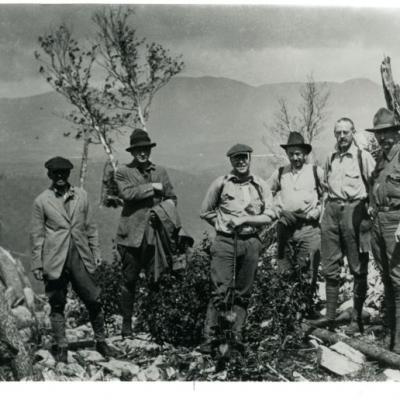
Forestry pioneers gathered on Mount Carrigain in 1919 to study five-year old slash. From left: Henry S. Graves, chief of the U.S. Forest Service and Society leader; J.J. Fritz, forest supervisor; Franklin Reed, district forester; Philip Ayres, Society forester; Allen Chamberlain, journalist and later to become president of the Appalachian Mountain Club; and C.B. Schiffer, district ranger. (Photo: USFS archives)
1901
Eight concerned citizens form the Society for the Protection of New Hampshire Forests. Their mission: to protect the White Mountains, which are rapidly being clear-cut.
1904
Mission Statement adopted: "The Society is a forestry association seeking to perpetuate the forests of New Hampshire through their wise use and their complete reservation in places of special scenic beauty."
1908
The Forest Society urges the state of New Hampshire to buy Crawford Notch. It does three years later.
1909
As a result of Forest Society urging, the state of New Hampshire appoints a state forester, and passes its first forest fire prevention laws.
1911
The Weeks Act is passed by Congress, after intense lobbying by the Forest Society and other conservation groups, leading to the establishment of the White Mountain National Forest.
The Forest Society buys 656 acres on Mount Sunapee to save it from being clear-cut.
1912
The Forest Society buys 148 acres around Lost River Gorge.
1915
The Forest Society acquires title to 600 acres on Mount Monadnock, beginning a process that ends up protecting more than 4,000 acres on the landmark mountain.
1918
The Forest Society begins work to acquire 1,500 acres on Mount Kearsarge.
1920
The Forest Society releases two breeding pairs of Minnesota beavers at Lost River. Prior to this, beaver had been extinct in New Hampshire for 30 years.
1923
The Forest Society leads a campaign to purchase 6,000 acres in Franconia Notch, including the Old Man of the Mountain, the Flume, the Basin, and two mountain lakes.
The Flume at Franconia Notch
1927
The Forest Society helps the state to buy Franconia Notch. The Forest Society retains ownership of 913 acres, including the Flume, and runs the park for 20 years until 1947.
1932
The Forest Society opens its first annual Nature Camp at Lost River. 90 years later, the Forest Society is still teaching people about the wonders of forests.
1934
The Forest Society helps defeat a proposal to build a "skyline drive" across the Presidential Range.
1937
The Forest Society begins publication of its magazine, Forest Notes, which is still published today.
1943
The Forest Society helps protect land surrounding Echo Lake and White Horse Ledge in North Conway.
1942
The state passes a constitutional amendment to end the annual taxation of growing timber — a victory the Forest Society had fought for since 1901.
1945
The Forest Society helps form the New England Forestry Foundation to promote better forest practices.
1948
The Forest Society transfers its 1,116 acres on Mount Sunapee to the state of New Hampshire.
1949
The Forest Society brings the Tree Farm program to the state, which encourages landowners to manage their woodlands for the long term.
1950
The Forest Society gives its final 520 acres on Mount Kearsarge to the state for the Frank Rollins Memorial Park, honoring the Forest Society's first president.
1959
The Forest Society opposes a super highway through Franconia Notch.
1960
Mr. & Mrs. Clarence L. Hay give the Forest Society 675 acres of woodland on Lake Sunapee.
Hay Reservation
1962
The Forest Society stops a plan to floodlight the Old Man of the Mountains.
Working with the Audubon Society of New Hampshire, and the state Fish & Game department, the Forest Society purchases land in the Hampton Salt Marshes to thwart a major development project.
1963
The Forest Society leads the way on legislation that creates town conservation commissions.
1966
Thirty-eight towns now have conservation commissions (by 2014 there will be 216 commissions).
1969
Plans for a nuclear power plant at Seabrook spur the Forest Society to lobby for extensive review of all major power installations.
1970
The federal government withdraws its plans for a tunnel and four-lane highway through Franconia Notch.
The Forest Society forms an interstate coalition to fight a proposed east-west superhighway across Vermont, New Hampshire and Maine.
The Forest Society opens an EcoCenter at Mount Monadnock to teach the 75,000 annual visitors about the mountain's ecology.
1971
The Forest Society negotiates its first conservation easement, which allows landowners to keep their land while preventing future development.
1972
The Forest Society begins a campaign to protect Sandwich Notch — the last unprotected notch in the state.
1973
After years of debate, the legislature enacts Current Use taxation, allowing millions of acres of land to remain as open space. A plan for a smaller parkway through Franconia Notch wins Forest Society support.
1974
The Forest Society purchases 726 acres on Gap Mountain. The next year, Mrs. Francis Fiske donates the south peak to the organization.
The Forest Society owns 7,189 acres in the state.
Gap Mountain
1976
The Forest Society celebrates the re-opening of the Monadnock-Sunapee Greenway, first laid out by Forest Society President Phil Ayres in 1925.
1978
Groundbreaking for the Forest Society's new headquarters begins. The award-winning Conservation Center gets over 80% of its heat from the sun and is an appropriate symbol of the organization's commitment to renewable resource use.
1982
The Forest Society works to get a bottle bill passed in the state, but it fails by one vote.
1983
The Forest Society helps raise awareness about the impacts of acid rain on New England's forests, laying the groundwork for important amendments to the Clean Air Act.
1984
The Wilderness Act passes the US Congress, designating 77,000 acres in the White Mountain National Forest as wilderness. Forest Society President Paul Bofinger chaired the committee that reached consensus on the bill.
The Forest Society owns 16,184 acres in the state.
1986
The Forest Society starts the Trust for New Hampshire Lands/Land Conservation Investment Program, a public-private six-year partnership that would protect more than 100,000 new acres in the state.
1987
A 10-year management plan is approved for the White Mountain National Forest. The Forest Society played a lead role in helping finalize the plan.
1989
The Forest Society, the state, The Nature Conservancy, and the U.S. Forest Service help save 40,000-acre Nash Stream forest in northern New Hampshire.
1990
The Forest Society serves on the Northern Forest Lands Council to find ways to sustain the four-state, 26-million acre forest and its people.
1993
The Forest Society creates the New Hampshire Conservation Institute to enhance and streamline its education and research efforts.
The Forest Society produces its award-winning Guide to Logging Aesthetics and a companion video to promote low-impact forestry without high impact costs.
1994
Forest Society reservations add up to 24,584 acres.
1995
The Forest Society creates its Living Landscape Agenda, a two-pronged plan to save special places and take care of land into the next century.
1997
The Forest Society acquires its 100th reservation - the High Watch Preserve in Effingham and Freedom.
High Watch Preserve. Photo Credit Jeff Sluder
1999
The Forest Society becomes the first private landowner in New Hampshire to have its land green-certified by SmartWood.
2001
The Forest Society celebrates its 100th anniversary — a century of outstanding accomplishments in the conservation and reservation of New Hampshire's forests.
2002
The Forest Society and the Museum of New Hampshire History launch a joint-project entitled Claiming the Land: Our Past, Our Future, Our Choice.
The New Hampshire House and Senate pass legislation regarding all-terrain vehicles (ATVs). The bill sets a policy for new ATV trails on state land and increases registration fees with revenue directed to enforcement, education, and trail acquisition. The Forest Society lent strong support to this bill.
The Forest Society, New Hampshire Public Television, and Cross Current Productions collaborate to produce Livable Landscapes: Chance or Choice , a one-hour documentary about citizens combating sprawl in their communities.
2003
The French Wing addition to the Forest Society's Conservation Center earns national recognition for innovation in "green building" design and construction. The U.S. Green Building Council awards its gold certification to the organization under the rigorous standards of the Leadership in Energy and Environmental Design program.
The Forest Society, federal and state officials, and other partner conservation organizations celebrate the permanent protection of 171,000 acres in northern New Hampshire.
The Connecticut Headwaters Project is the largest contiguous block of New Hampshire land in private ownership, comprising roughly three percent of the state.
2007
The Forest Society protects 3892 acres in fiscal year 2007, including 845 acres (10 projects) in forest reservations (land we own, 2,995 acres (27 projects) on which we hold conservation easements, and 52 acres (two projects) that we protected and will be transferred to a third party.
The Forest Society is also pleased to announce permanent LCHIP funding. The New Hampshire Land and Community Heritage Investment Program (LCHIP) is an independent state authority that makes grants to New Hampshire communities and non-profits to conserve and preserve New Hampshire’s most important natural, cultural and historic resources. Through this grant program every dollar invested brings in significant local, private, federal funds, and helps New Hampshire businesses and traditional business districts.
2013
The Forest Society is accredited by the Land Trust Alliance Accreditation Commission. The Commission, established in 2006 as an independent program of the Land Trust Alliance in Washington, DC, conducts an extensive review of each applicant’s policies and programs to determine if the applicant meets the national standards for excellence, upholds the public trust and ensures that conservation efforts are permanent.
2019
On February 13, 2019, a fire at The Rocks destroyed two historic buildings that we used for office space, programming, a gift shop and farm operations. In the wake of this devastating loss, the Forest Society had an opportunity to rethink the vision for this iconic North Country destination and launched a restoration project in 2020.
After nine years of hearings, meetings, and strategy sessions, the NH Supreme Court dealt a death blow to the Northern Pass project by ruling that the Site Evaluation Committee had indeed followed appropriate legal protocol in denying Northern Pass a certificate of site and facility. It was big win for New Hampshire’s landscapes, forests, and communities. Once again New Hampshire citizens stood their ground for the things they hold dear: open spaces unmarred by commercial development, downtowns with scenic charm, communities with a sense of who they are and what they want to be, farms that provide livelihoods for families, and the overwhelming sense that New Hampshire citizens, not some company from away, have the right—even an obligation—to determine their future.
2020
The Forest Society protected the Ammonoosuc River Forest in Bethlehem as its 191st forest reservation.